
Cómo elegir el manómetro de presión adecuado para tu vehículo o taller
Tire Gauge Buying Guide
Cómo elegir el manómetro de presión adecuado para tu vehículo o taller
Choosing the Right Tire Pressure Gauge: A practical guide for industry professionals, retail partners, and car owners.
October 29, 2026
A tire pressure gauge may look like a simple tool, but products with similar appearances can differ greatly in durability, readability, accuracy, and long-term value. Choosing only by the lowest price can lead to weak housings, unclear displays, unstable readings, or higher replacement costs.
For most buyers, three factors provide a useful starting point: material, price, and display type. These factors should then be checked against the intended application, pressure range, valve design, accuracy requirement, and expected frequency of use.
¿Cómo afecta el material a un manómetro de presión?
The outer housing protects the display, sensor, valve connection, and internal air path. However, buyers should not judge the complete product by the shell alone. The chuck, connector, hose, seals, and internal pressure components also affect service life.
ABS o plástico de ingeniería
Lightweight and economical. Suitable for personal vehicles, promotional products, emergency kits, and occasional pressure checks.
Aleación de aluminio
Offers a useful balance of low weight, impact resistance, and a more premium feel for frequent home or workshop use.
Piezas de acero y latón
Often used in chucks, threaded fittings, and pressure pathways where strength, sealing, and repeated connection matter.
For a retail product used only a few times per month, a well-made plastic gauge may be sufficient. For a repair shop or tire service bay, a metal body, impact protection, durable hose, and replaceable sealing parts usually provide better long-term value.
Material must also match the working environment. Tools exposed to oil, moisture, drops, vibration, extreme temperatures, or repeated daily use need stronger protection than gauges stored in a vehicle glove box.
¿Cómo deben comparar los compradores los precios de manómetros?
Price reflects more than the housing material. Sensor quality, calibration, display technology, hose construction, chuck design, packaging, inspection procedures, and order quantity can all affect the final quotation.
| Price Level | Typical Features | Best For | Buyer Focus |
|---|---|---|---|
| Entry Level | Plastic housing, basic display, compact design | Personal use, emergency kits, promotions | Basic accuracy, valve fit, battery access |
| Mid Range | Stronger housing, multiple units, improved grip or hose | Regular drivers, garages, retail brands | Repeatability, durability, display clarity |
| Professional | Robust construction, wider range, replaceable parts or inflation controls | Workshops, fleets, tire service centers | Calibración, vida útil, repuestos, soporte |
The cheapest unit price is not always the lowest total cost. Importers should also include tooling, custom packaging, freight, duties, spare parts, and possible product returns. Compare suppliers using the same specification and trade terms so that quotations are genuinely comparable.
¿Qué tipo de pantalla es mejor?
Manómetros de dial analógico
Analog gauges use a pointer and printed scale. They are easy to operate, normally do not require a display battery, and can be practical for general workshop use. Buyers should check dial size, scale clarity, protective covers, and pointer stability.

Manómetros LCD digitales
LCD models show a direct numerical reading and often support PSI, bar, kPa, and kg/cm2. They are convenient for consumers and technicians who want to change units quickly. Battery quality, screen visibility, auto-off functions, and sensor protection should be reviewed.
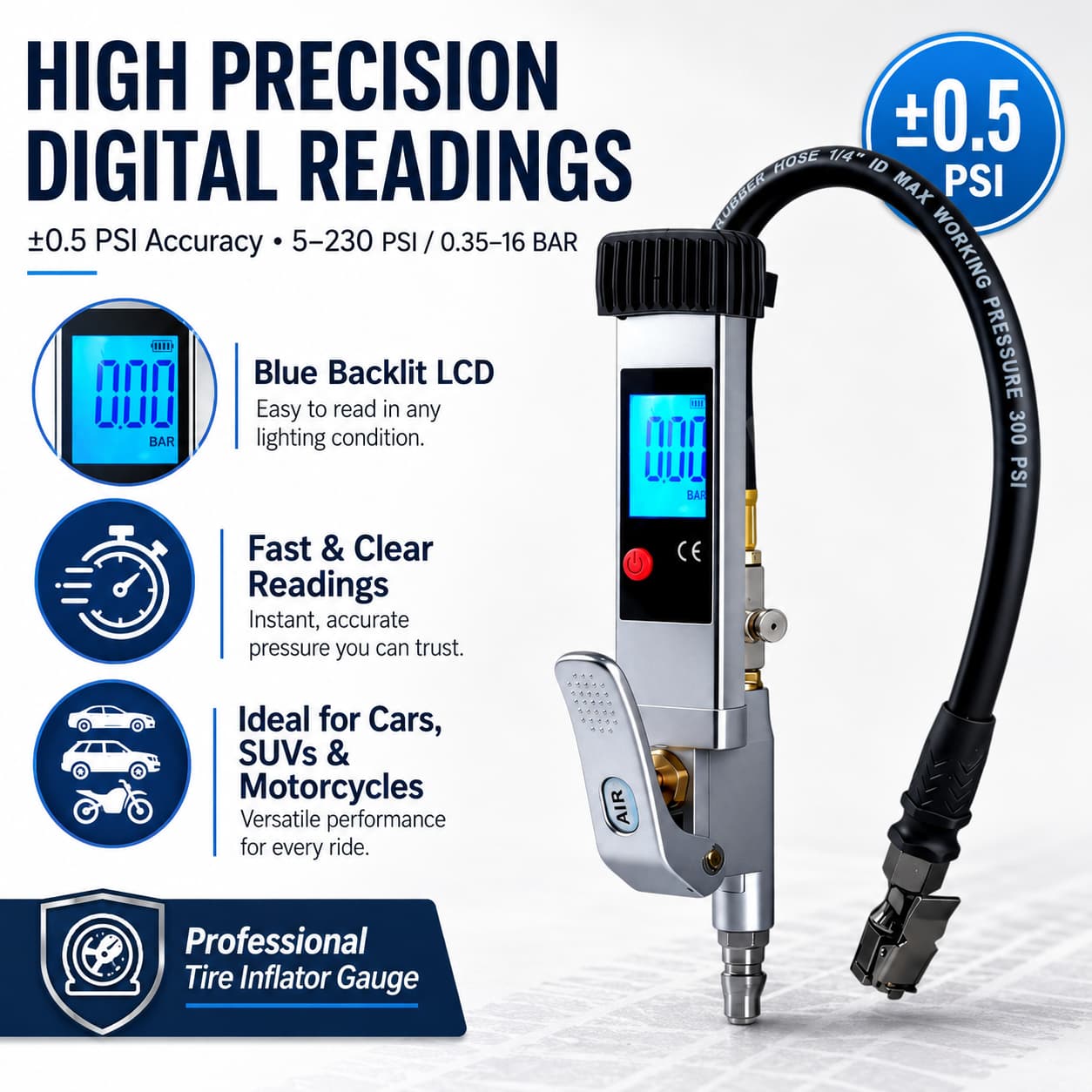
Manómetros digitales LED
LED displays offer strong contrast and are easy to read in dim garages or roadside conditions. They may use more power than basic LCD screens, so buyers should compare charging or battery arrangements as well as display brightness.
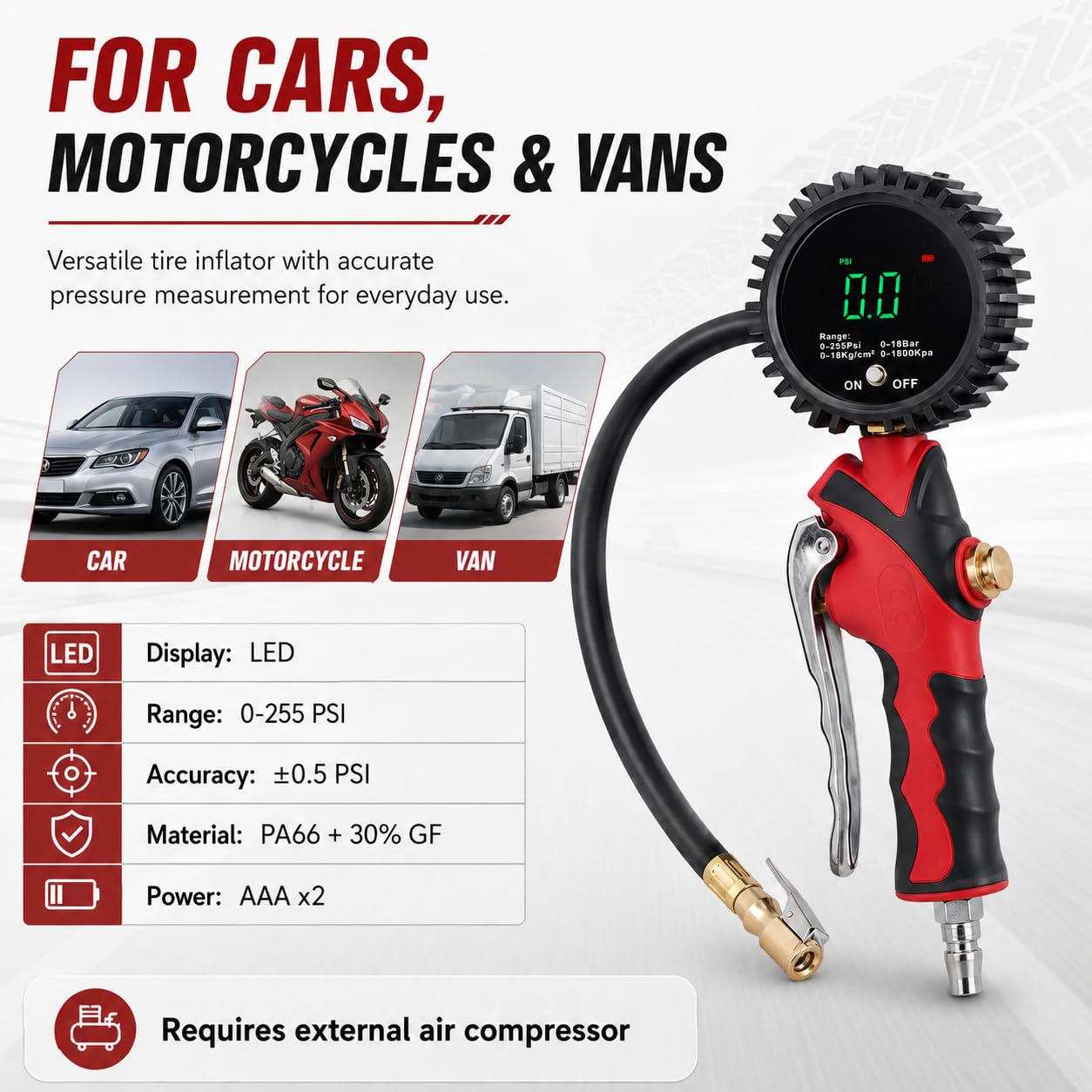
Lista de compra en cinco pasos
- Define the application. Decide whether the gauge is for personal vehicles, retail distribution, repair shops, fleets, or heavy-duty service.
- Confirm the pressure range and units. Normal readings should fall comfortably within the gauge’s supported range.
- Match material to usage. Consider drops, moisture, oil, temperature, vibration, and daily operating frequency.
- Test the display and connection. Review readability, response speed, valve compatibility, hose reach, and chuck sealing.
- Verify quality documents. Request samples, test results, certification information, packaging details, and model-specific specifications before bulk purchasing.
Preguntas frecuentes
1. Is a metal tire pressure gauge always better than a plastic one?
No. A well-designed plastic gauge can be suitable for occasional personal use. Metal housings are usually more appropriate when the tool will be dropped, transported frequently, or used repeatedly in a professional workshop.
2. Are digital tire pressure gauges more accurate than analog gauges?
Display type alone does not determine accuracy. Sensor quality, mechanical design, calibration, temperature, and manufacturing control all affect the reading. Buyers should compare the stated accuracy and sample test results.
3. Why are some tire pressure gauges much more expensive?
Higher prices may reflect stronger materials, better sensors, wider pressure ranges, longer hoses, improved chucks, calibration, certification, replaceable components, or more extensive quality inspection.
4. What should importers test before placing a bulk order?
Test several pressure points against a trusted reference gauge. Also inspect display clarity, unit switching, battery access, air leakage, valve compatibility, hose quality, packaging, and performance after transport.
5. Have SEAPENG tire pressure gauges passed compliance testing?
Yes. SEAPENG tire pressure gauge products have passed RoHS and CE testing. Buyers can request the documents associated with the exact model and order specification they plan to purchase.
Conclusión
The right tire pressure gauge is not simply the cheapest or most attractive model. Material determines how well the tool handles its working environment, price should be evaluated through total purchasing cost, and display type should match the user’s reading habits and operating conditions.
For global buyers, the strongest purchasing decision combines suitable materials, a clear and practical display, verified accuracy, dependable valve connections, compliance documentation, and responsive supplier support.
Encuentra el manómetro SEAPENG adecuado
Explore tire pressure measurement solutions for automotive retailers, workshops, distributors, and OEM/ODM projects.
Explore Tire Pressure GaugesMás manómetros SEAPENG
SEAPENG DP-708 Manómetro inflador digital, 5–230 PSI
Digital tire inflator gauge for checking, inflating, and deflating tires with a connected air source. Features a 5-230 PSI range, LCD display, aluminum alloy body, and 24″ hose for garages and tire shops.
SEAPENG DP-708 Manómetro inflador digital, 5–230 PSI →SEAPENG BW-L01 Manómetro inflador digital de presión, 5-230 PSI
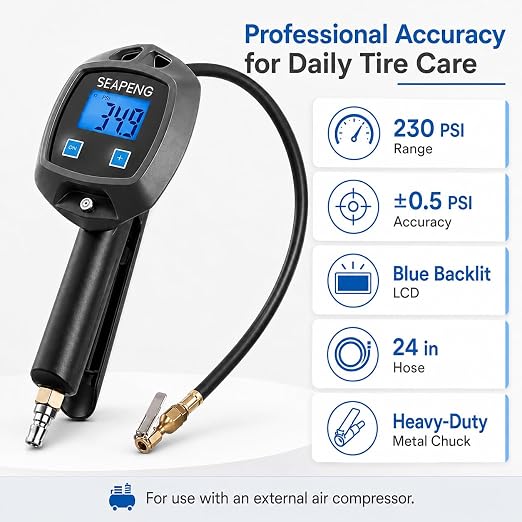
Comprueba, infla y ajusta la presión con una sola herramienta. Conecta el SEAPENG BW-L01 a tu compresor para un inflado rápido, lecturas digitales claras y control preciso.
SEAPENG BW-L01 Manómetro inflador digital de presión, 5-230 PSI →Explora los modelos SEAPENG
Review the specifications, compatibility and operating requirements on each product page before choosing a model.
- SEAPENG DP-B05 Digital Tire Pressure Gauge
- SEAPENG DP-T01 Digital Tire Pressure Gauge
- SEAPENG DP-T02 Digital Tire Pressure Gauge
- SEAPENG DP-T04 Digital Tire Pressure Gauge
- SEAPENG BW-002 Digital Tire Pressure Gauge, 5-230 PSI
Contact SEAPENG for model selection and wholesale requirements.